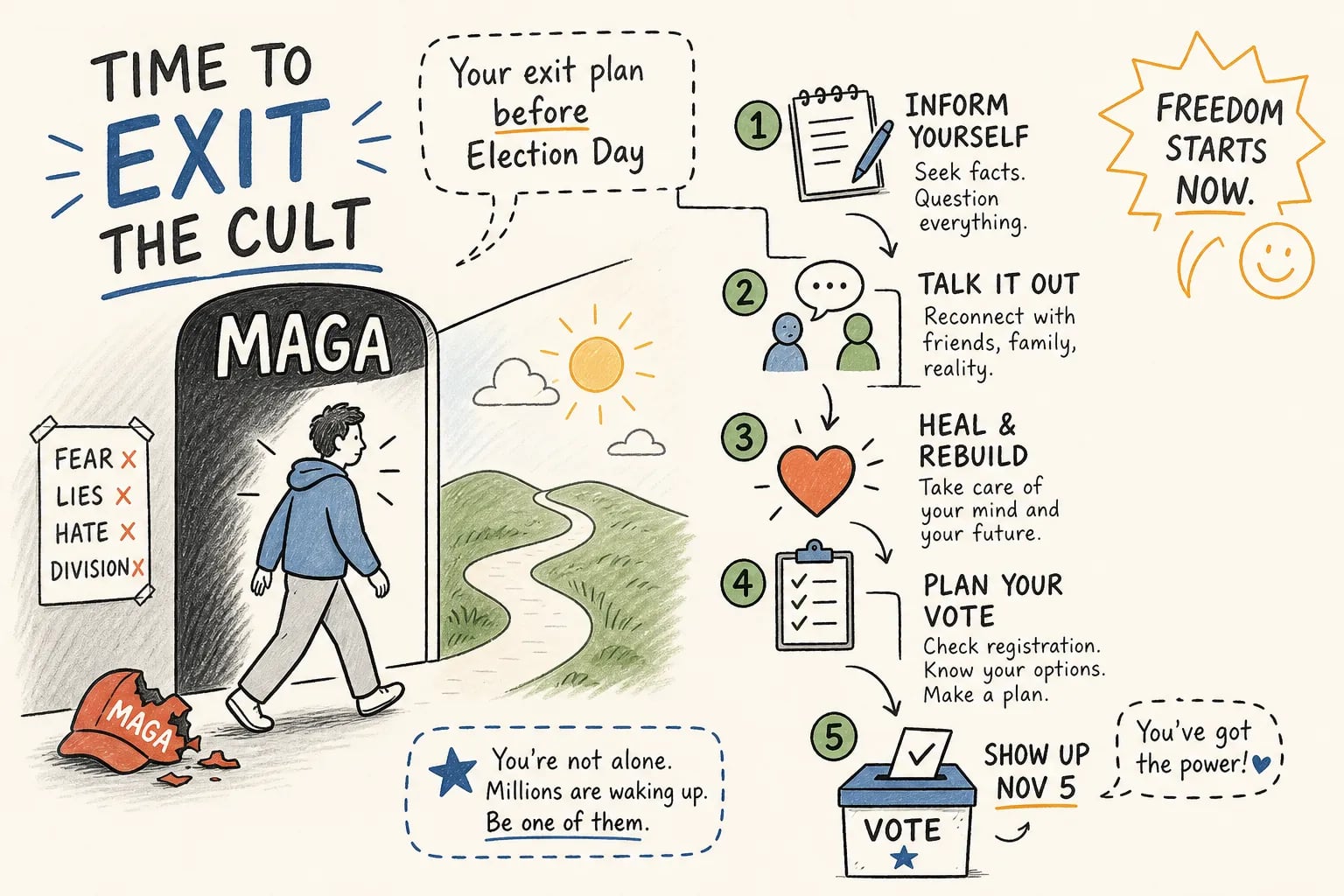
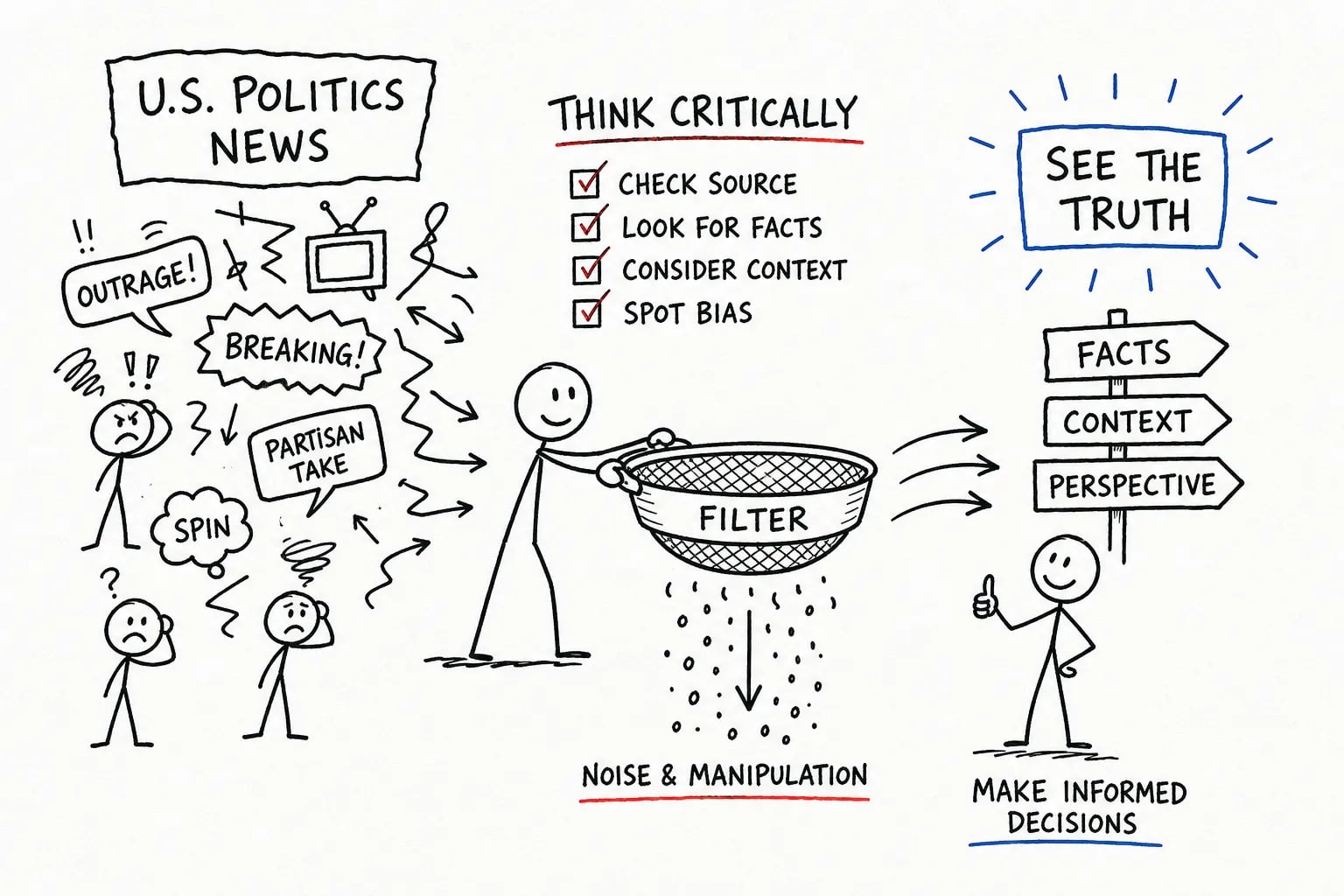
U.S. politics news is engineered to keep you reactive, not clear-headed. If you’ve ever read a political headline, felt your chest tighten, and walked away angrier than when you started, that’s not a character flaw. That’s the system working exactly as designed.
Partisan outlets across the political spectrum take the same event and frame it in completely different ways, using language chosen to trigger a specific emotional response in a specific audience. Many readers never learn to see the gap between a fact and a framing choice, and so they spend years consuming political content without a real filter. At Leaving MAGA Guide, our program is designed for people who have lived that experience, absorbing U.S. political news for years without the tools to evaluate it critically. The framework they build in that process is something any reader can develop.
By the end of this article, you’ll have a concrete framework for reading American political news with clear eyes: how to spot spin, trace stories back to primary sources, evaluate polls honestly, and build news habits that protect your thinking instead of hijacking it.
Why U.S. politics news feels designed to overwhelm you
The volume problem is not an accident
The sheer number of U.S. political headlines on any given day is itself a strategy. When readers are overwhelmed, they stop evaluating and start defaulting to the source that already feels familiar and confirms what they believe. That dynamic is not a side effect of modern media, it’s the business model. Attention, not accuracy, drives publishing decisions, and the more emotionally overwhelming the coverage, the more clicks it generates.
Look at any major story right now, the Supreme Court’s rejection of mail-ballot restrictions ahead of the 2026 midterms, the Senate’s stalled crypto bill, the ongoing scrutiny of former official Kash Patel, and you’ll find the same events covered in completely different emotional registers depending on the outlet. One headline reads like a constitutional crisis. Another reads like a political win. The underlying facts are identical. The framing is doing all the work.
How emotional framing shuts down critical thinking
When U.S. political news arrives wrapped in fear, outrage, or tribal identity cues, the brain shifts out of analytical mode and into reactive mode. This is not a weakness specific to any political group. It’s human neuroscience, research on threat perception and media exposure consistently shows that emotionally charged political content activates fear responses before deliberate reasoning kicks in. Partisan media on every side is designed to exploit this. Threat framing, demonizing language about the opposing side, and emotionally charged imagery all work by making you feel before you think.
The goal of understanding this is not to shame yourself for having been caught in it. The goal is to recognize the mechanism so you can interrupt it. Once you know what the trigger looks like, you can pause before the reaction sets in.
What separates real reporting from partisan spin
The anatomy of a credible political story
Legitimate journalism in U.S. political news has a few consistent features. Named sources are attributed clearly. Original documents are linked or referenced. Multiple perspectives on the same event are represented. The difference between a reporter’s statement and a source’s claim is made plain. When the Supreme Court rejected Trump’s mail-ballot restrictions, solid reporting on that story cited the actual court order, named the justices, and described what the ruling does and does not mean for upcoming elections. Spin on the same story stripped out that context and replaced it with emotional conclusions the court itself never made.
You don’t need a journalism degree to spot this difference. You just need to ask one question before accepting a story: where is the original source? If the article doesn’t point you toward one, that gap is worth noticing, and worth filling yourself before drawing conclusions.
How to read U.S. politics news headlines critically: four red flags
Four specific signals indicate a piece is prioritizing narrative over fact. Watch for any of them when you’re reading the latest U.S. political updates:
- Unnamed “insiders” cited throughout with no description of their role or relationship to the story.
- Loaded adjectives in straight news copy, not in clearly labeled opinion columns, but in reporting itself. Words like “radical,” “disastrous,” or “stunning” used in the body of a news article rather than in commentary.
- Selective quoting that strips context from a longer statement to make it mean something different than the speaker intended.
- No link or reference to the original document being discussed, making independent verification impossible.
These are reading tools, not accusations against any specific outlet. Every major outlet slips on some of these at some point. The goal is to notice when it’s happening and adjust your confidence in the story accordingly.
How to trace any political headline back to its primary source
Where official records actually live
For the most common types of U.S. government news stories, primary sources are publicly accessible and free. Supreme Court decisions are published at the Court’s official site, including slip opinions and the full United States Reports. Senate and House legislation, including bill text, amendment history, and vote records, lives at Congress.gov. Executive orders and presidential actions are published on the White House’s official presidential actions archive and in the Federal Register. Agency policy changes appear directly on the relevant agency’s official site.
This is a habit, not an expert skill. When the Senate stalled the crypto Clarity Act, the actual bill text was available at Congress.gov within hours of the vote. When Kash Patel faced scrutiny over travel and the 2020 election probe, the committee records and hearing schedules were public. Tracking down these documents typically takes only a few minutes and completely changes what you can verify on your own.
Using fact-checkers as a second layer
Fact-checkers are a useful second step, not a replacement for primary sources. Three of the most reliable ones for general American politics breaking news are FactCheck.org, PolitiFact, and AP Fact Check. FactCheck.org, a nonpartisan project of the Annenberg Public Policy Center, is strongest for U.S. policy and science claims and publishes corrections with a date and explanation when new information changes a story. PolitiFact focuses on public-figure statements and uses a documented rating system. AP Fact Check is built for fast verification of breaking political claims.
For international dimensions of Washington news and analysis, Reuters Fact Check handles fast-moving misinformation well. The Washington Post Fact Checker is particularly useful for congressional and presidential claims. None of these are perfect, and none substitute for reading the actual source document. But using one or two as a regular checkpoint reduces how much unverified information you absorb in a typical news cycle.
Reading polls and approval numbers with clear eyes
What the current numbers actually mean
Polling in 2026 tells a specific story about U.S. politics today. A Reuters/Ipsos survey conducted in early 2026 put Trump’s approval at around 33%, among the lowest readings of his political career. Across Quinnipiac, YouGov, and Times/Siena polling, Democrats are leading Republicans on the generic congressional ballot, typically by single digits to low double digits. The dominant issue driving these numbers is economic dissatisfaction: cost of living, financial stress, and a widespread sense that conditions are worsening. For the 2026 midterms, that environment matters because the party out of power historically gains ground in midterm elections, and the current polling suggests those conditions are forming.
Approval ratings alone, though, don’t decide elections. Voter turnout, district composition, and how many disapprovers actually split toward the opposition all factor in. The numbers give you context, not a prediction.
How polls get weaponized to push a narrative
The same set of approval numbers can be framed as a “historic collapse” by one outlet and a “stable floor of support” by another. Before you accept any poll as evidence of a political trend, ask four questions: What is the sample size? What is the margin of error? Who commissioned the poll? How was the question worded? A poll commissioned by a political action committee and a poll commissioned by an independent research university are not equivalent, even if they report the same topline number.
Wording matters enormously. Asking “Do you approve of the President’s economic policy?” and “Do you think the economy is heading in the right direction?” can produce very different numbers while appearing to measure the same thing. Once you start asking these questions automatically, you’ll read polling coverage in a completely different way.
Rebuilding your news-reading habits from the ground up
Why your habits matter more than your source list
The most important variable in how well you consume U.S. political news is not which outlet you choose, it’s the mental habits you bring to reading. Readers who consume news reactively, scrolling through whatever is emotionally loudest, feel manipulated no matter where they go. Readers who bring structure get more signal and far less noise. A good source read badly is still a bad experience. A mediocre source read with discipline is actually useful.
This is the shift that matters most, and it’s also the hardest to make alone, because the habits that feed reactive news consumption were usually reinforced over years, not days.
A structured path: the “Focus to Pivot” course from Leaving MAGA Guide
The “Focus to Pivot” course from Leaving MAGA Guide was built specifically for people who feel like their news habits have been working against them. It combines identity-rebuilding exercises with reading skills practice using real-world political events, treating media literacy as both a civic skill and a personal development practice. You’re not just getting a list of tips. You’re working through a step-by-step process designed to rewire how you engage with political information at the level of habit, not just awareness.
For anyone who has spent years inside a political media ecosystem that prioritized emotional activation over critical thinking, a structured exit from reactive consumption is not a luxury. It’s the foundation for everything else.
A personal media diet for U.S. politics news
How to build a source mix that covers your blind spots
A practical media diet for following U.S. political news has three components. First, one wire service, AP or Reuters, for bare-facts reporting with minimal interpretive framing. Second, one analysis source with transparent methodology: a nonpartisan policy research site or academic publication that shows its work. Third, a primary-source habit: check SCOTUS.gov or Congress.gov for the actual text behind any major story before accepting a headline’s summary of it.
Format diversity matters as much as outlet diversity. Reading a court transcript alongside a news summary of that same decision gives you an entirely different picture of Washington news and analysis than either source alone. Transcripts, committee hearing records, and agency reports are dry, but they are the real thing, and they protect you from second-hand framing in a way no editorial process can.
Knowing when to step back from the feed entirely
Staying informed does not require constant consumption. There is a meaningful difference between being current on U.S. politics today and being swept up in the daily outrage cycle, and that difference shows up in your ability to think clearly about what you’re reading. Checking in on major developments twice a day with intention beats scrolling for three hours with anxiety. You are allowed to set limits on your news consumption without guilt. That boundary is not disengagement from civic life, it is a form of civic self-care that actually improves your long-term political judgment.
Start here, and keep building
The core framework is straightforward. Real reporting has traceable sources. Primary documents are publicly accessible and free. Fact-checkers help you verify disputed claims quickly. And your reading habits matter more than any single outlet’s reputation. Reading U.S. politics news critically is a skill, not an innate talent, and anyone can build it deliberately with the right structure.
For readers who want a more systematic path, the “Focus to Pivot” course from Leaving MAGA Guide was designed for exactly this transition: turning overwhelmed, reactive news consumers into clear-eyed, self-directed civic participants. It combines the practical reading tools covered here with the deeper identity work that makes those tools stick. You can explore it by visiting Leaving MAGA Guide directly.
FAQ, U.S. politics news: how to verify and where to look
Where can I find primary sources for U.S. government news?
Congress.gov hosts all federal legislation, vote records, and amendment histories. Supreme Court opinions appear at the Court’s official site. Executive orders are published in the Federal Register and on the White House’s presidential actions archive. Most agency policy changes post directly to the relevant agency’s site. These are free, searchable, and updated quickly after major decisions.
Which fact-checkers are most reliable for American political news?
FactCheck.org, PolitiFact, and AP Fact Check are widely used and methodologically transparent. Reuters Fact Check is strong for international and fast-moving stories. No single fact-checker covers everything, using two as a cross-reference gives you a more complete picture than relying on one alone.
How do I know if a poll about U.S. politics today is trustworthy?
Look at four things: sample size (larger is generally more reliable), margin of error (smaller means tighter confidence), who commissioned the poll (independent vs. partisan funder), and how the question was worded. A poll with a clear methodology disclosure is almost always more credible than one that buries those details.
Staying informed about U.S. politics news without being manipulated starts with the habits you build today. That takes time and practice, but the skills are learnable, the sources are free, and the clarity you gain is entirely within your reach.