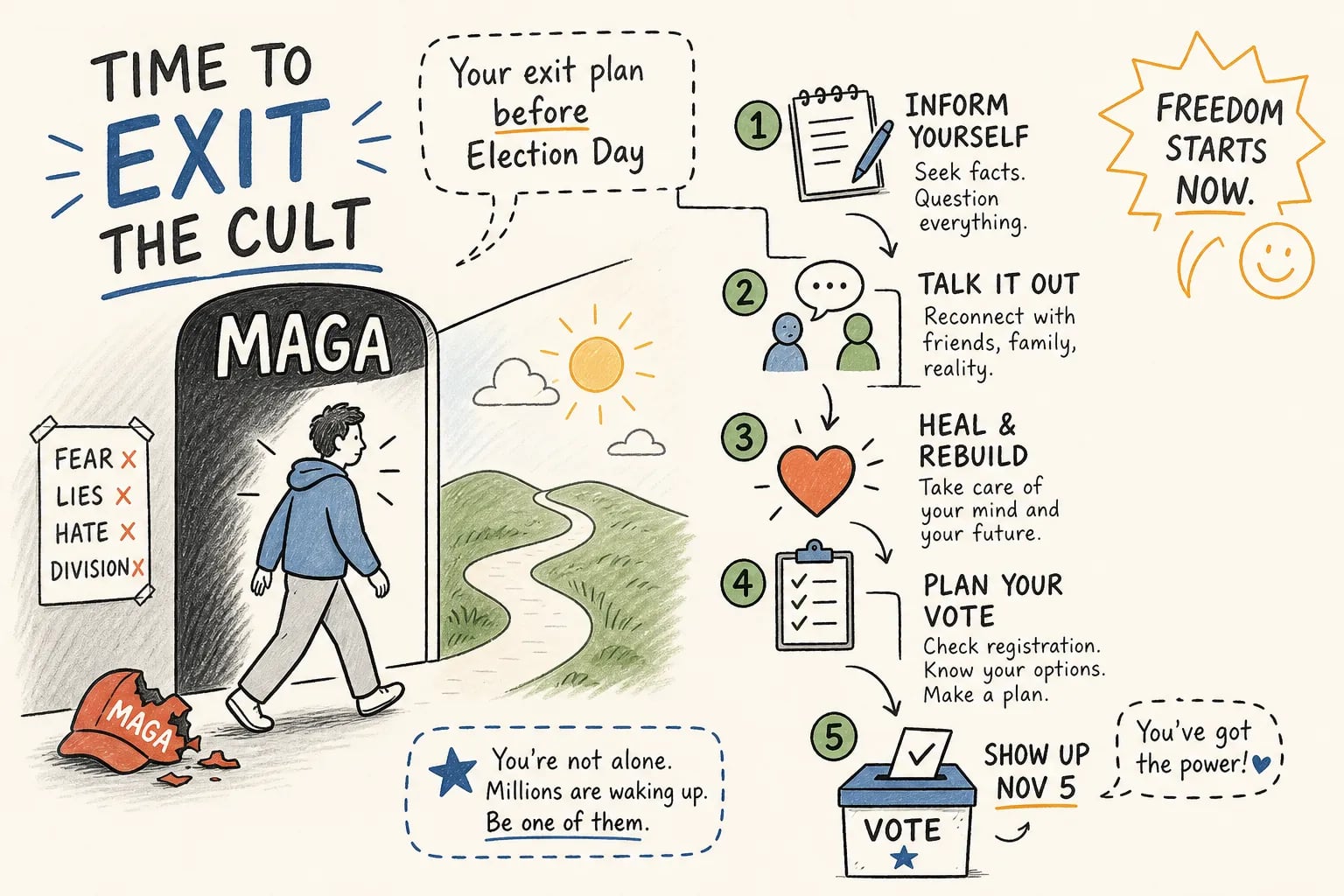
Midterm election is the time to change your voting decision, and this cycle makes that clearer than most. Presidential elections arrive with the weight of a freight train. The noise is deafening, the social pressure is real, and the emotional stakes feel personal in a way that makes clear thinking almost impossible. Midterm elections are different. They carry less thunder, less tribal heat, and far less pressure from the people around you. That quieter atmosphere is exactly what makes this cycle the right moment to ask yourself an honest question: does my vote still reflect who I am?
If you’ve been sitting with some quiet doubt about your last ballot, you are not alone. Many voters are in the same place right now, wondering whether the candidates they supported have actually delivered on what was promised. That kind of reflection isn’t weakness. It’s what civic participation is supposed to look like. Platforms like Leaving MAGA Guide offer free YouTube-based civics content and workshops that help ordinary people engage with democracy outside the noise of partisan media, on their own schedule and their own terms.
By the time you finish this article, you’ll know how to research your choices without falling back into a partisan loop, understand what the 2026 mail-in ballot rules actually mean for your voting plan, and know the concrete steps to confirm or update your vote before November 3.
Why midterms carry more weight than most people realize
Midterm elections don’t carry the same psychological freight as presidential races. The tribal pressure, the identity-coded messaging, the friends and family weighing in on every choice, that volume gets turned way down. From your neighbors and family to your social media feed, everyone has an opinion about your presidential vote, and they’re not shy about sharing it. In a midterm, that pressure eases considerably. That lower emotional temperature makes midterms a better moment to evaluate candidates on their actual record rather than on personality, fear, or team loyalty.
What’s on the ballot in a midterm is also worth understanding. In 2026, all 435 House seats and 34 Senate seats are up for election, along with dozens of state offices and ballot measures. These are concrete policy decisions: healthcare, housing, infrastructure, education funding. This is not a personality contest. These are the offices that write the laws affecting your daily life.
History is direct about what midterms actually do. The president’s party has lost House seats in 20 of the last 22 midterms since 1938, averaging 26 to 28 seats lost per cycle. That means individual votes in midterms land in a context where the political map is already shifting. A changed vote isn’t swimming upstream. It’s participating in a historically consistent pattern of course correction that voters across the country have used for nearly a century.
What “changing your vote” actually means, and why it isn’t a betrayal
Many voters tie their ballot choice to who they are as a person: their community, their family history, their sense of belonging. That connection is real and it deserves respect. But unpacking it is the first honest step toward voting with clarity rather than obligation. A vote is a tool, not a loyalty pledge. The candidate you supported in the past is accountable to the results they delivered, not to your continued support regardless of what they actually did.
Think of it this way: if a mechanic didn’t fix your car last time, you don’t owe them your car again. You take it somewhere that will actually get the job done. Applying that same practical logic to your ballot isn’t cynical. It’s rational.
Re-evaluating a candidate or a party is not the same as rejecting who you are. It’s applying your actual values to what’s in front of you right now. Many voters cast ballots under heavy social pressure or emotionally charged messaging that didn’t give them the full picture. Having more information now is a reason to use it, not to feel ashamed. You don’t need to explain your ballot to anyone. This is between you and the voting booth.
How to research candidates without falling back into the same partisan loop
The biggest trap in political research is confirmation bias. If you only read sources that already agree with you, you’re not researching candidates, you’re building a case for a decision you already made. Breaking that loop requires going to tools that aren’t built around a political agenda, and those tools exist and are free.
Start with these practical, nonpartisan resources:
- VOTE411.org from the League of Women Voters: enter your address, see exactly what’s on your ballot, and compare candidates’ own responses to standardized questions
- Vote Smart: free, factual, unbiased information on candidates and their voting records
- Ballotpedia: clear summaries of candidates, ballot measures, and election history
- Your state’s official voter guide: the most direct source for what your state says about the candidates and measures you’ll be deciding on
When you’re looking at a candidate, focus on three things: their voting record versus their campaign promises, what legislation they’ve actually funded or sponsored, and their public statements over time rather than just recent campaign messaging. Cross-reference at least two or three sources. One source is a starting point, not a conclusion.
For voters who want a judgment-free space to rebuild their civic thinking skills, Leaving MAGA Guide offers YouTube-based live content covering democracy, civic action, and midterm voting engagement in plain language, no preaching, no partisan spin, just civic education for people who want to think for themselves. Their civics workshop uses real-world political events to strengthen critical reading and evaluation skills, and it’s designed for people who’ve felt burned by political media before. Both resources are entry points, not prescriptions. The goal is to walk into the polls having formed your own opinion, not someone else’s.
Why the 2026 midterm election is the time to change your voting decision
The combination of lower social pressure, high-stakes down-ballot races, and new voting rules in 2026 creates a specific window. Voters who want to make a different choice this cycle have more practical clarity available to them than in any recent election, if they take the time to use the tools above before November 3.
What the 2026 mail-in ballot rules mean for your voting plan
This is the part of 2026 that’s genuinely different from past cycles, and it matters for your planning. Specifically, in August 2026 the USPS finalized a rule tied to President Trump’s March 2026 executive order. The rule requires states to submit the names and addresses of voters intended to receive mail ballots, along with new barcode-formatted ballot envelopes, through a federal portal. Under this rule, USPS would not deliver mail ballots to voters whose information is not on the state-provided list.
The legal situation remains in flux (as of September 4, 2026). A federal judge lifted what was described as the last major injunction blocking implementation on August 26, clearing the administration to impose these requirements. A separate federal court in Boston then issued a temporary block on key provisions of the USPS rule on August 27, and that dispute remains ongoing. The First Circuit also let stand a district court injunction covering 23 states that had challenged the executive order. In practical terms, the rules may still shift before November 3. Readers are encouraged to check reputable news sources and their state election authority for the latest status.
The practical takeaway is straightforward: don’t assume your mail-in ballot experience will work the same way it did in 2022 or 2024. If your state hasn’t submitted voter lists to USPS under the new rule, your ballot may face delivery issues. Contact your county election office directly to confirm your status. Voters in states where the executive order is blocked by court injunction may face different conditions than voters in states where the rule is being enforced. If mail-in uncertainty concerns you, in-person voting remains an unaffected option for most voters.
Changing your vote: absentee ballot deadlines and mail-in rules by state
If you’ve already mailed a ballot but want to change your choice, act immediately, deadlines move fast and vary sharply by state. The rules below reflect the current framework; confirm the latest with your local election office before taking action.
How to check your voter registration status and update your ballot before Election Day
Checking your voter registration status takes under two minutes and should be your first step. Go to your state’s official election website or use one of these nonpartisan gateways: Vote.org, USAGov, VOTE411, or the “Can I Vote” tool from the National Association of Secretaries of State. Enter your name and date of birth, along with any additional identifier your state requires. Depending on your state, that may include:
- Your street address or county
- The last four digits of your Social Security number
- Your driver’s license number
Most states return your registration status, polling place, and any mail ballot tracking information within seconds. Wyoming is a notable exception and requires a direct call to your local election office.
Here’s what the general framework looks like for changing a submitted ballot:
- Connecticut: you can withdraw a submitted absentee ballot from your town clerk until 5 p.m. the Friday before Election Day
- Minnesota: you can cancel an absentee ballot until two weeks before Election Day; after that point, cancellation is not allowed
- Michigan: you can request a new absentee ballot through a written request to your city or township clerk, with a deadline of 2 p.m. the Saturday before the election if mailed, or 4 p.m. the Monday before if made in person
- Georgia: you must bring the physical absentee ballot to the polls to cancel it; you cannot cancel without it
- Pennsylvania: you generally need to surrender your mail ballot and return envelope at the polls to vote in person; without it, you may be directed to cast a provisional ballot
- Wisconsin: once your absentee ballot has been received by the clerk, it is treated as final and cannot be changed
The universal rule across all states is the same: if you want to change your ballot, contact your issuing election office immediately. Waiting even one day can eliminate your options. The November 3, 2026 general election date is confirmed. Many state deadlines for mail ballot requests fall in late October, check your state’s official deadline, as they vary widely. Connecticut, for example, accepts requests as late as November 2, while Alabama and Massachusetts cut off as early as October 27.
Voting on your own terms is what democracy is actually for
No vote you’ve cast in the past locks you into any future vote. Democracy is built on the assumption that people will update their decisions as conditions change, as promises go unkept, and as information becomes clearer. That’s not a flaw in the system. That’s the system working as intended.
You now have the practical foundation to act on that right. You know how to check your voter registration status, you understand the shifting mail-in ballot landscape for 2026, and you have real tools to research candidates outside of partisan noise.
Before Election Day, spend even an hour with the free YouTube live content and civics workshop through Leaving MAGA Guide. It’s a space designed to let you engage with democracy without being steered toward any particular candidate or conclusion. The goal there, and the goal of this article, is the same: give you the clarity and the tools to make a vote that belongs entirely to you. The 2026 midterm election is your time to change your voting decision, and now you have everything you need to do it right.
Discover a Path to Clarity with the Leaving MAGA Guide
Are you ready to uncover the truth? In a time when political division seems overwhelming, ask yourself: When will it be too much to ignore?
We believe in empowering you to examine the evidence and make informed decisions.
Our tailored approach offers a safe space to build your reading skills and develop a deeper understanding of the political landscape. With decades of experience in teaching, publishing, and political studies, we’re here to guide you toward a brighter future.
Explore our unique offerings:
- Confidential Stress Test: Assess your perspective with our MAGA Compass, designed to help you navigate the complexities of today’s political climate.
- Focus to Pivot Course: Join our supportive YouTube series to gain the tools and confidence needed to transition away from divisive ideologies.
Together, let’s illuminate the path to a more transparent and accountable future. Embrace the power of knowledge and take the first step toward change with the book, Betrayed by Trump? A Guide to Self-Discovery and the Rewards of Your Positive Mindset on Amazon.
BOOK INFO – The book, Betrayed by Trump? A Guide for Self Discovery and the Rewards of Your Positive Mindset – is available on AMAZON – here’s the link – it is only $10, available in paperback and e-pub Kindle.
COACHING INFO – Visit our main website for details and coaching appointments. We offer a 3 hour package of transformation using your intelligence and creativity.
MERCH INFO – Every identity switch needs a new costume. We have our own Red Hat, and inspirational Lady Liberty designs for you to enjoy. Check out the styles HERE.
THE MAGA COMPASS – Test it out for yourself – Confidential and private, your political diagnostic tool, self test, check your values and pressure for MAGA and the voting booth on November 3, 2026.
Stay tuned for thought-provoking episodes that not only recount historical events but also spark discussions on the importance of ethical leadership and civic engagement. Together, let’s pave the way for a future where the government truly serves the people with fairness and justice. Hope to see you at the MAGA EXIT Countdown Tuesday nights!