
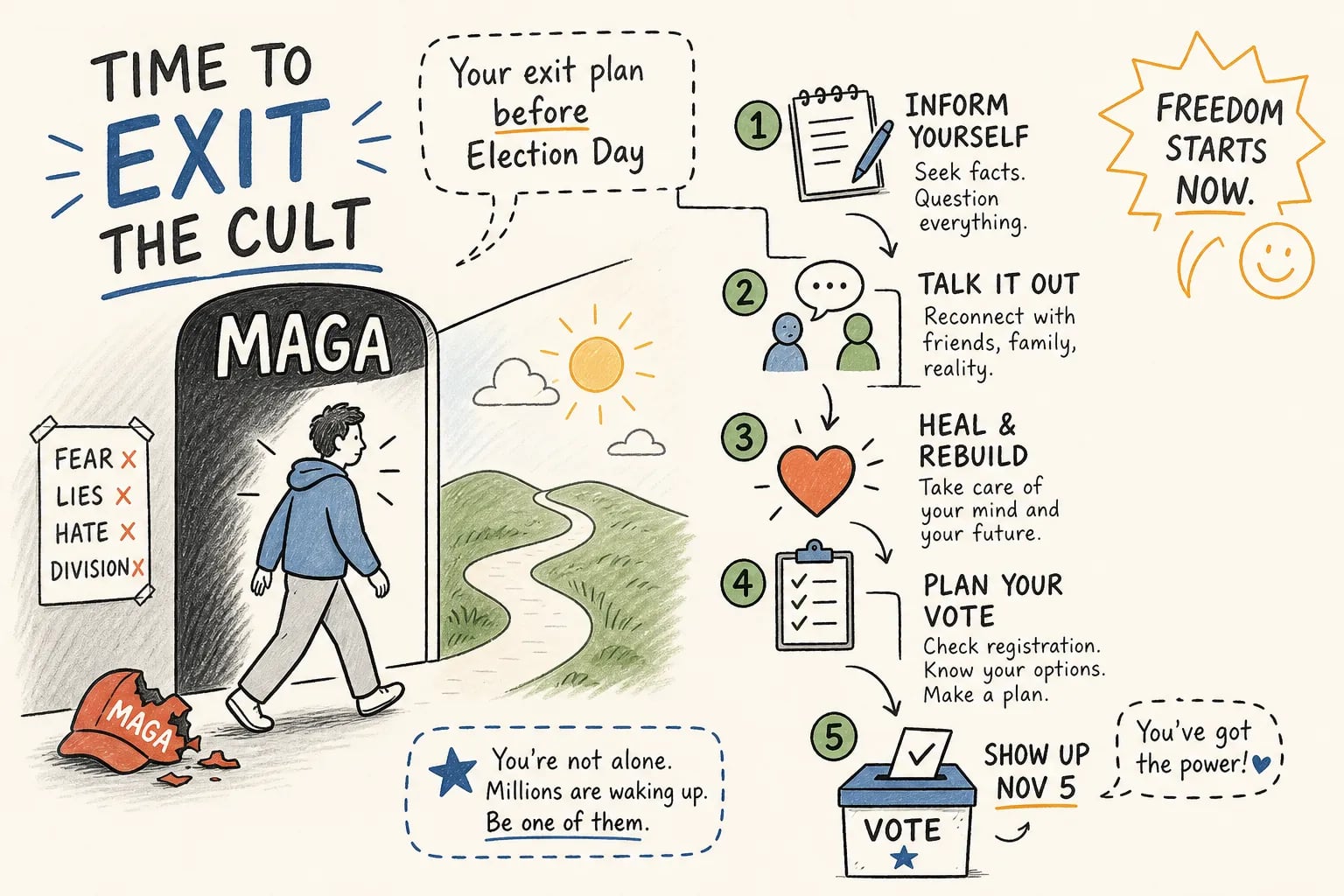
November 3, 2026 is 60 days away. If you’ve been quietly wondering whether your doubts about MAGA are real, the MAGA exit countdown to the November election is no longer abstract, it’s sitting right in front of you. This guide isn’t about convincing you of anything. It’s a practical walkthrough for the weeks you have left: what to do with the thoughts in your head, what to do with your voter registration, and what to do with the media habits that have been shaping your worldview.
The exit isn’t a single moment. It’s a series of moves, and you have time to make them deliberately.
You’re Not as Alone in This as You Think
Start with where things actually stand. The doubt you feel inside the MAGA coalition is more widespread than the movement admits publicly. A CNBC poll from July 2026 found that 57% of registered voters said they would be less likely to vote for a candidate who describes themselves as a MAGA supporter. That’s not a fringe number. That’s a majority of the electorate signaling the same discomfort you may be feeling privately.
Inside the base itself, NBC News reported that Trump’s strong approval among self-identified MAGA Republicans dropped 8 points between April and July 2026. That doesn’t mean the coalition is collapsing, but it does mean you are not the only one asking harder questions than you were a year ago. Your instinct is matching the data.
Prominent figures have started walking away. According to reporting from early 2026, Joe Kent publicly resigned from a Trump administration post citing disagreements with administration decisions. Tucker Carlson has made increasingly critical statements about the movement’s direction. These aren’t obscure voices, they were inside MAGA. The point here isn’t to score political points against anyone still in it. Leaving is something real people do, and it’s happening now.
Your Identity Work Comes Before Anything Civic
Before you re-register to vote or change what news you’re reading, give yourself time inside one honest question: who are you now? That’s not a political question yet. It’s a personal one, and skipping it means the civic steps won’t stick. Identity work is the foundation, not an optional warm-up.
A few reflective questions can get you started. Do you feel defensive in conversations you used to enjoy? Do you find yourself fact-checking things you never questioned before? Are you quietly protecting your political beliefs from your own scrutiny? These aren’t traps. They’re entry points into a process that many people have walked through when stepping back from any high-commitment ideological community.
Studies on political disengagement and ideological transition, including research from social psychologists who study group exits, indicate that people navigating what might be called MAGA regret often freeze instead of acting, particularly as election pressure builds. Regret without a framework tends to harden into shame, and shame stops movement. The reframe that actually works: regret is information, not a verdict. It tells you something has shifted. It doesn’t tell you that you’re a bad person. It tells you that you’re paying attention. That’s where the real work starts.
MAGA Exit Countdown: A Structured Path Through the 60-Day Window
Most content about leaving MAGA falls into one of two categories: attack journalism that talks about you rather than to you, or vague advice with nowhere to go. The Improvement Arc inside Leaving MAGA Guide is designed to be neither. It’s a structured coaching program built specifically for people who don’t yet have the answers but are ready to start asking better questions.
The program’s design centers on identity rebuilding exercises, media literacy practice using real-world political events, and the MAGA Compass self-assessment, a reflective tool that helps you measure where you actually stand rather than where you used to stand. This is not a program built for people who already have a new political home. It’s built for people in the in-between, which is exactly where most people are when they first start questioning a movement they’ve been part of for years.
Within this countdown to the November election, the program covers meaningful ground. The Focus to Pivot course walks through step-by-step identity rebuilding. The Sovereign Rewards content series explores what civic identity can look like after leaving MAGA. The broader civic re-engagement framework treats November 3 as a milestone, not just a calendar date. If you’re going to take one structural step this week, start with The Improvement Arc at Leaving MAGA Guide. The 60-day window is enough time to work through it.
Re-Registering Your Vote and Reclaiming Your Civic Voice
A large share of former MAGA supporters are still registered Republicans. Some want to change that before voting. Some don’t. Both choices are valid, but the deadlines are real and non-negotiable, so here’s the practical calendar you need.
Registration deadlines vary by state, and several are approaching quickly:
- Georgia and Arizona: October 5, 2026. That’s roughly one month away. If you live in either state and haven’t confirmed your registration status, do it today. Check your state’s official election website for county-specific rules.
- Pennsylvania, Iowa, and California: October 19, 2026 for standard registration. California also offers same-day conditional registration through November 3. Verify your county’s specific cutoff before assuming statewide rules apply.
- Michigan and Wisconsin: Both allow in-person same-day registration on Election Day, though online and mail-in deadlines fall earlier. Confirm your method of registration directly with your state’s official election site.
The civic layer of an exit is real and deserves attention. Something worth naming directly: you don’t need a fully formed new political identity to vote on November 3. You don’t need a new party affiliation or a clear ideological home to participate in an election. Civic participation and ideological transition can happen simultaneously. You’re not voting to prove anything to anyone, you’re voting for your own clarity, on your own terms.
Recalibrating What You Read and Watch Before You Vote
People leaving MAGA have often been inside a closed media loop for a long time, specific channels, specific voices, specific framing. The news felt urgent, emotional, and constant. That’s not accidental. Media researchers have documented how certain political media ecosystems are built around repetition, emotional flooding, and us-versus-them framing. When contradicting information enters the loop, the system responds with dismissal and reframing. These are design features, not glitches. They are not a reflection of your intelligence for having been inside them.
Recalibrating your media diet doesn’t require a dramatic overhaul. Media literacy research suggests that gradual source diversification is more effective than swinging abruptly to the opposite end of the dial. Start with one new credible outlet that covers topics you already follow. Read one issue across two different sources before drawing a conclusion. When a surprising claim appears, check whether two or more independent outlets report the same thing before accepting it as settled.
The Focus to Pivot course inside Leaving MAGA Guide uses real-world political events as practice material for this kind of calibration work. It builds skills for separating commentary from reporting, identifying missing context, and recognizing the difference between a source that cites evidence and one that relies on emotional intensity to hold your attention. Building this habit before November 3 changes how you walk into the voting booth. Your decision will reflect a broader picture than any single media loop can give you.
The MAGA Exit Countdown to November: 60 Days Is Enough
You’ve already started by being here, and that counts for more than it might feel like right now. The next 60 days can cover a complete picture: recognizing that your doubt is widely shared, doing the identity work before anything else, using The Improvement Arc as a structured guide through the transition, handling voter registration before your state’s deadline, and gradually widening your information diet so your vote reflects your actual values.
None of these steps require you to have everything figured out. That’s the point. The MAGA exit countdown to the November election isn’t a single moment of clarity where everything snaps into place. It’s a series of honest moves, made one at a time, in the weeks you have left before November 3. You don’t have to be certain. You just have to begin. If you’re ready to take one step today, start with The Improvement Arc inside Leaving MAGA Guide, the work you do now will matter long after Election Day.