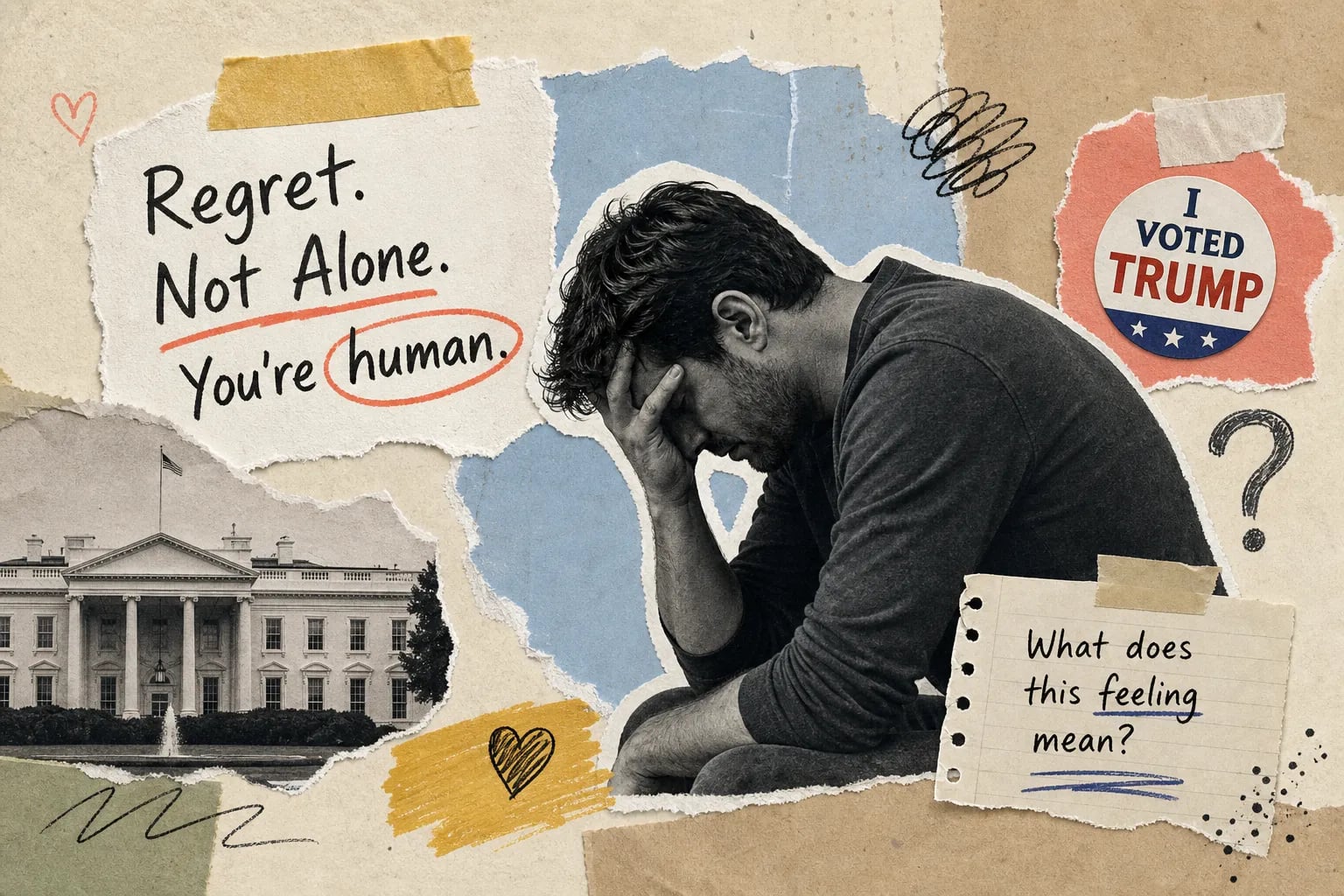
If you’re feeling regret and shame about your Trump vote, you haven’t said it out loud. Maybe not to anyone. But something has been sitting with you since the 2024 election, something heavy and hard to name. You voted for Trump. Things didn’t go the way you expected. And now you’re carrying a feeling that sits somewhere between disappointment, embarrassment, and a quiet kind of grief.
You are not alone in this. Not even close. National polling conducted between January and September 2026 consistently shows that somewhere between 1 in 8 and 1 in 5 Trump voters now say they regret their vote, have second thoughts, or would choose differently if they could go back. Even at the low end of that range, we’re talking about a staggering share of the electorate sitting with exactly what you’re sitting with.
This article isn’t here to score political points or make you feel worse than you already do. It’s here to name what’s happening, show you the data, and explain why this feeling isn’t a character flaw. It’s evidence that something in you is working exactly right. For people who want structured support moving through this, Leaving MAGA Guide exists specifically for this transition: a private, judgment-free space built for the millions who are done but aren’t sure what “done” looks like yet.
The numbers are bigger than you think
The polling range on Trump voter regret and shame is wide because different surveys ask different questions. A March 2026 Strength In Numbers/Verasight poll found 13% of 2024 Trump voters say they “strongly” or “somewhat” regret their vote. University of Massachusetts Amherst polling found 16% would change their vote outright, and 21% now describe themselves as having “second thoughts.” Navigator Research put the figure at 20%, describing it as roughly one in five.
The honest summary is a range of 13% to 21%, depending on whether the poll measured explicit regret, second thoughts, or willingness to vote differently. Every one of those measures is pointing at the same underlying experience. Even the most conservative estimate represents an enormous number of real people.
The true number may be higher than any poll captures. Admitting this feeling publicly, especially in red-state communities, rural towns, or households where MAGA identity runs deep, feels like a betrayal of the people around you. So people don’t raise their hand in polls. They confess it anonymously on Reddit. They say it in focus groups to researchers instead of neighbors. They post it online without their real name attached. Social scientists call this social desirability bias: people underreport views that feel stigmatized. Shame creates silence, and silence makes the data we have an undercount of what people are actually feeling.
Who’s carrying Trump voter regret and shame the hardest
The generational gap in regret is striking. Navigator Research data shows Trump voters aged 18 to 34 report regret at 30%. Among voters aged 35 to 54, that figure drops to 18%, and among those over 55, it falls to just 12%. Younger voters came into this election carrying specific economic frustrations: rent they couldn’t afford, student debt they couldn’t escape, grocery bills that kept climbing. The gap between what was promised and what they’ve experienced has been sharpest for them.
Racial and ethnic minority Trump voters show the highest regret rates of any group in the Navigator data. Black Trump voters report regret at 34%; Latino Trump voters come in at 32%; white Trump voters report regret at 16%. These communities often cast their votes as a protest against specific failures, crime, economic stagnation, and a sense that Democrats had taken them for granted. They are now measuring what they actually got against what they were told they’d get.
Independents and voters who don’t identify as MAGA themselves are also a high-regret group. Non-MAGA Republicans and independents who feel shame over their Trump vote show regret rates between 25% and 42% depending on the measure, with independent men hitting 37% in some Navigator data. These were persuadable voters who made a specific economic bet. Many now describe feeling politically homeless, neither willing to stay nor sure where to go.
What actually changed their minds
Economic pain is the most consistent answer across every poll and focus group reviewed. Inflation, grocery prices, tariffs, healthcare costs: voters expected relief and are still waiting for it. Navigator’s focus-group participants put it plainly, describing wages that aren’t keeping up with rising prices and frustration that healthcare costs were never seriously addressed. For a vote that was largely cast as an economic fix, the absence of that fix is the loudest part of the disappointment.
Foreign policy hit just as hard for many voters, and for a significant share it came as a genuine shock. The Iran war emerged as a top-cited reason for regret in both New York Times focus group coverage and Navigator’s summary findings. A substantial portion of Trump’s 2024 voter base was sold on a “no more wars” message. Unexpected military engagement abroad doesn’t register as a vague disappointment for those voters. It lands as a specific, policy-level betrayal of something they were explicitly promised.
Beyond policy, there’s a recurring emotional theme in focus-group language worth sitting with. Navigator’s reporting describes some regretters using the word “duped.” One focus-group participant said directly: “He views us as little peasants.” Another told Newsweek: “I see so many issues that are clear, yet there’s been no significant progress on any of them.” That theme, the sense of being promised something and then being deprioritized or ignored, shows up across surveys, focus groups, and anonymous online confessions with striking consistency.
When regret over your Trump vote turns into shame
Regret and shame are related, but they are not the same thing, and the difference matters more than it might seem. Regret is about the action: “I made a bad choice.” Shame is about identity: “I am the kind of person who made that choice.” Regret focuses outward on what happened. Shame turns inward and becomes a verdict on who you are.
Shame is harder to process than guilt or regret because it feels like a global judgment on your character, not just a specific mistake you can learn from and correct. It produces avoidance. It creates silence. It leads to self-punishment rather than reflection. And it makes people less likely, not more, to seek out information or change their behavior going forward. Researchers who study shame and guilt consistently find this pattern: guilt tends to motivate repair, while shame tends to motivate withdrawal.
Social media confessions from people in exactly this position reveal consistent emotional themes: feeling betrayed, feeling embarrassed in front of people who warned them, feeling maneuvered into a choice they wouldn’t have made with clearer information. Many describe a specific kind of isolation. They can’t talk to the people around them who are still fully committed, and they don’t feel welcome in the political spaces on the other side. That isolation is where shame lives and grows. Without a framework for moving through it, it tends to produce paralysis rather than progress.
Shame means your moral compass is still working
Not all shame functions the same way. There’s a meaningful distinction between shame that collapses inward, the toxic kind that leaves you feeling permanently broken, and shame that signals a misalignment between your actions and your values. The second kind is useful. It tells you something true.
Feeling ashamed of this vote means your values are still intact, that the outcome matters to you, and that you care what your choices say about who you are. That’s not a character flaw. That’s moral development in real time.
Every significant ethical turn in a person’s life involves looking back at a previous version of yourself and feeling uncomfortable with what they did. That discomfort is called conscience. It’s how people grow. Former Trump voters sitting with regret right now aren’t broken. They’re changing. And changing your mind when reality contradicts your expectations is one of the most honest things a person can do.
Leaving MAGA Guide exists precisely for this moment. Not to assign blame or demand apology, but to offer a private, dignified path through this kind of emotional and political transition. The platform includes a structured self-assessment that gives people a confidential way to examine what they actually value, along with programs that walk through the psychological dynamics of political manipulation and help people build a political identity that reflects who they are now, not who they were told to be.
What this moment means going forward
When one in five Trump voters expresses some form of regret and shame over their Trump vote, that’s not just a collection of private feelings. It’s a political reality with real consequences. Voter remorse research consistently shows that regret over a candidate or party choice is a strong predictor of party switching in the next election. It also increases information-seeking, reconsideration, and civic attention in ways that simple apathy never does.
The concern worth naming is what happens when widespread regret has no healthy outlet. Civic withdrawal doesn’t help anyone. Voters who get stuck in shame without a framework for moving through it are more likely to disengage entirely from elections, not just from one party. That outcome serves no one’s interests, including the people who care about a healthier democracy.
History rewards the people willing to look at their choices honestly. The voters sitting with regret right now are also the voters closest to re-engaging on their own terms, outside of any movement’s script. Changing your mind based on new information isn’t weakness or flip-flopping. It’s how adults navigate a world that keeps changing.
The regret and shame you’ve been carrying over your Trump vote has a name. You’re far from alone in carrying it. And it’s telling you something true about your values, not something shameful about your character. The next step isn’t self-punishment. It’s honest reflection and intentional re-engagement. Leaving MAGA Guide is built exactly for this transition, a structured, private starting point for when you’re ready to figure out what comes next. You voted once. You get to decide what comes after that.